- In The News!
- [Articles posted from the last 12 months]
|
Sierra-Diablo Spring Swapfest!
April, 2008: Sacramento Bee

|
-
-
Strike up a hobby
Matchbook collectors have a burning desire
Belleville News-Democrat, Sep. 24, 2007:
Q. I have oodles of matchbooks that I used to collect. Now,
I'd like to sell them. Know of any local clubs?
-- G.P.P., of Fairview Heights
A. If it hadn't been taken by a dating company, match.com
would have made the ideal name for the Rathkamp Matchcover Society
Web site.
Rathkamp, which recently turned 66, is the world's oldest
and largest matchcover group, with more than 1,000 phillumenists
("lovers of light") collecting every conceivable category
of matchbook cover. Lee Nott, a Rathkamp member from Fairview
Heights, has seen at least one rare cover sell for $4,000.
But before you start dreaming of untold riches, Nott quickly
adds that people don't join Rathkamp for the money. The vast
majority of matchbooks sell for no more than a penny or two.
Members often give away bushel baskets of covers. Instead, Nott
says, people join Rathkamp to strike up relationships with other
matchbook lovers.
"The real attraction is the friendships that you make,"
said Nott, who just last month was instrumental in organizing
Rathkamp's annual national convention in St. Louis, which drew
175 other collectors.
"Like if I came across a steamboat matchcover, I would
set it aside. Then, at the next convention, I'd give it to a
collector from England who comes over to collect anything that's
maritime-related. And, I've got a friend in O'Fallon who collects
railroads and military, so he gets all of those."
He is also good friends with noted Belleville West High School
sports historian George "Bill" Nold, of Belleville,
who has albums filled with Belleville-related covers. Small's,
Katz's, Augustine's, Belleville National Savings Bank, Wessel's
-- they're all there from days gone past. In fact, Nold says
he can take you on a walk through Belleville of yesteryear from
Signal Hill to the east end of town with his matchbook collection.
But it was the near-loss of a friendship that got Nott into
the hobby. One day while working at Scott Air Force Base 25 years
ago, a colleague walked up to his desk and threw four matchbooks
on his desk.
"He said, 'You (so-and-so), don't you dare put stuff
like that in my jacket pocket again!'" Nott recalled. "'Because
if my wife found them, she'd kill me!' I was dumbfounded. I had
no idea in the world what he was talking about."
Immediately, gales of laughter erupted from the other side
of Nott's cubicle, and the man stormed off to find the true culprit
-- without the matchbooks.
"So I turned them over, and each one had a picture of
a scantily clad girl on them, and they were from East St. Louis,"
said Nott. "A fellow behind me said, 'You can go down there
and get a girl for five or ten bucks.' And, I said, 'I don't
want to get a girl, but I think I'll keep the matchbooks because
that's something different.'"
Apparently, that's the way people have been thinking almost
ever since Joshua Pusey was credited for inventing the matchbook
in about 1892. Just two years later, the first matchcover advertisement
appeared. In 1896, for example, the Mendelson Opera Co. bought
100 blank matchbooks and had hand-drawn pictures and messages
of the opera's leading players put on them. Today, one such book
survives and is insured for at least $25,000 by Diamond International.
At its peak, an estimated 12.5 billion matchbooks circulated
in the United States annually, manufactured by some 400 companies.
The largest, Nott said, was Universal Match Corp., headquartered
in St. Louis until 1987. It wasn't long ago, according to Rathkamp,
that Americans made and used about 800 billion matches a year.
(One three-pack-a-day smoker could go through 22,000 a year.)
It wasn't long ago, either, that Nott found himself almost
buried in some of those matches. In 2003, for example, a friend
in St. Louis died and left Nott his entire collection -- about
360,000 books.
"And, that was a small collection," said Nott. "I
know people who have over 3 million. So, you can understand they
become prolific like bunny rabbits."
On rare occasions, Nott has seen covers go for relatively
large amounts of money. After Charles Lindbergh returned from
his historic flight to Paris, for example, a set of 150 books
was printed for a commemorative banquet in New York. About 12
years ago, one man paid $4,000 for one.
"At the time, he thought there were only three in existence,"
Nott said. "Since then, nine or 10 more have surfaced."
Even a rare group of covers featuring sports legends of the
1920s and '30s usually go for $1.50 each tops -- if they are
in near-mint condition. Most of your common hotel and restaurant
covers -- even from decades ago -- go for a penny or two at best.
That's one reason, matchcover collecting is mostly done by
people over 40, Nott says. When they're not playing video games,
young people, he fears, want something they can make a quick
buck from rather than putting in the time and love it takes to
build a unique matchcover collection.
And, with more venues banning smoking, it's becoming harder
to even find matchbooks; where once there were 400 U.S. companies
that churned them out, only four remain.
It's even become too much for Nott, now 64. He has disposed
of his entire collection that once numbered more than 600,000
covers -- except one category.
"To be honest, I kept the casinos only because it gives
me an excuse and makes it legitimate to my mother that it's OK
for me to go to the casinos," Nott said, laughing. "I
mean, I'm in my 60s, so you'd think that she could accept that
I'm going to do what I damn well please but she doesn't like
my going to the casinos. So, I go out to get matches."
If you'd like to explore selling your collection, Nott suggests
calling George Lux in St. Louis at (314) 351-1181, although he
will be away until mid-November. Otherwise, call Nott at 398-8782
or go to the Rathkamp Internet site at www.matchcover.org and
match up with someone through their links.
Send your questions to Roger Schlueter, Belleville News-Democrat,
120 S. Illinois St., P.O. Box 427, Belleville, IL 62222-0427
or rschlueter@bnd.com |
-
August 14, 2007
- St. Louis Post-Dispatch [convention coverage]
|
-
Duane Ready 's Right on 'Cue'!
August, 2007
- Billiards Digest
|
- ...and the article went on for three more pages! Great write
up.
-
- For ticket holders,its a
Lotto fun
- By William Kenny, Times Staff Writer, Northeast Times
(Philadelphia) July 19th, 2007
-
- When most people look at lottery tickets, visions of dollar
signs light up their eyes. But when Somerton resident Steve Gilbert
looks at them, he sees works of art. No matter if theyre
old or new, big or small, expensive or a dime a dozen, all lottery
tickets have a certain aesthetic allure, Gilbert contends.
Thats not the kind one gets when one buys into the Daily
Number or Powerball jackpots, but rather the scratch-off variety.
Naturally, or perhaps unnaturally, Gilbert and hundreds of other
lottery-ticket aficionados are more interested in collecting
the colorful game cards, rather than the riches that the cards
rarely provide to the redeemer.Dozens of Gilberts colleagues
in this unlikely pastime plan to gather in the area this weekend
for the Global Lottery Collectors Societys 19th annual
Lotovention at the Courtyard by Marriott next to Philadelphia
Park in Bensalem.
The free public event, scheduled for Friday through Sunday, is
meant to give GLCS members an opportunity to barter tickets with
collectors from 35 U.S. states, five Canadian provinces and beyond,
as well as offer non-members an opportunity to see what the hobby
is all about. Most folks, when they first hear about lottery-ticket
collecting, seem perplexed by the point of it all. "We get
that reaction a lot from people," conceded Gilbert, co-chairman
of the convention. What may seem like a straightforward endeavor
is actually quite intensive and time-consuming. Gilberts
collection is in the millions, with 700,000 different tickets,
including multiple copies of many.
His organization maintains a list of every ticket variety ever
produced in every state. The total is over a million and growing,
as states generally introduce new ticket designs each month.
"Its impossible to get every ticket," he said.
"Now they put out a dozen (new ones) a month." Gilbert
treats the roster, which fills a loose-leaf binder several inches
thick, as a checklist, marking the ones he has and thereby tracking
the ones he needs.
His collection includes early Pennsylvania Lottery scratch-offs
from the mid-1980s and present-day varieties. Some originally
sold for as little as $1, while the newer ones offering million-dollar
prizes have $10 or $20 price tags.
There are almost as many different kinds of collectors as there
are tickets, he explains. Some do it geographically, while others
pay more attention to the graphic elements on the tickets. "Some
people collect by theme, like sports, patriotic and animals,"
Gilbert said.Other popular and interesting themes include the
various holidays on the calendar and the signs of the zodiac.
Some are printed as "contact sets," where three individual
tickets, when placed side by side, create a single image.
- Gilbert, meanwhile, seems to be going after pure volume in
his collection. Best of all, he doesnt have to pay for
most of his tickets. He simply hangs out at the convenience store,
waiting for others to discard their losers. Over the years, he
has developed a rapport with some retailers so that they supply
him with invalid copies marked "sample" or "void"
and used for promotional purposes. "Fortunately, its
an inexpensive hobby," he said, before rethinking his statement.
"Well, it could be expensive."
- Two men one from Lancaster, the other from New Jersey
created the Global Lottery Collectors Society two decades
ago when, as its explained, "they each found out that
there was more than one person who collects these things."
Pennsylvania had just issued its first sets of scratch-off tickets,
following the lead of pioneering Massachusetts.
The first GLCS "convention" was held in the Lancaster
home of co-founder Bill Pasquino, co-chairman of this years
Lotovention. Gilbert got involved several years later as an outgrowth
of another of his many hobbies, matchbook collecting.
One evening, Gilbert was hosting an out-of-state matchbook collector
for dinner when the guest asked where he could buy lottery tickets.
That sparked a conversation about the new hobby. When the guest
went home to Illinois, Gilbert began sending all of Pennsylvanias
new tickets to him. "I was feeding his hobby," Gilbert
said. "After about two years of me sending him tickets and
him sending me tickets, I became a collector."
As one of 17 GLCS members from Pennsylvania, Gilbert acquires
many copies of each of the states newly issued tickets.
Then he ships them out to other traders throughout the nation.
They, in turn, send him tickets from afar, such as California,
Arizona and Idaho.
- Like Gilbert, most collectors dont trade winning tickets.
They cash them in like everybody else does.
However, a few odd souls actually collect valid, but unused,
tickets their satisfaction in owning pristine copies outweighs
their curiosity about whether riches could exist behind a tickets
shiny surface, just one scratch away."Some collect mint
tickets just from their own state," Gilbert said. "And
there are a few that trade mint tickets with each other."
You dont find many "mint" tickets among the high-priced
varieties when a simple scratch could mean the difference between
missing a mortgage payment and retiring to Easy Street.
Gilbert cautions that waiting to play any valid ticket isnt
the wisest move, since just about all tickets eventually expire,
so the state wont honor them even if redeemed as a winner.
Personally, Gilbert has never encountered that dilemma.
"Ive always played them and I still play," he
said. "Im always looking for that big win, I guess."
Ironically, the most hes ever won on a single ticket was
a mere $100. "Thats it," he said. "But I
have a friend who won fifty-thousand once. He moved from Pennsylvania
to Florida and started a business." If that friend is smart,
he didnt start a lottery-ticket trading shop. Unlike other
collectibles, such as stamps, coins and baseball cards, lottery
tickets dont gain any value over time. In fact, they lose
it. Spent or voided tickets can sell for pennies on the dollar.
"Its a hobby. It fills your time," Gilbert said.
"I trade with people. I correspond with people.
"Theres a market for certain tickets to be sold, but
its not a hobby youre going to get rich with."
For information about the Global Lottery Collectors Society and
the 19th annual "Lotovention," visit www.lotterycollectors.com
or e-mail Steven Gilbert at SteGil919@aol.com
|
- Matchbooks strike chord with Burnett
- By Mary Grothause, The Delphos Herald
- Published: Monday, June 25, 2007
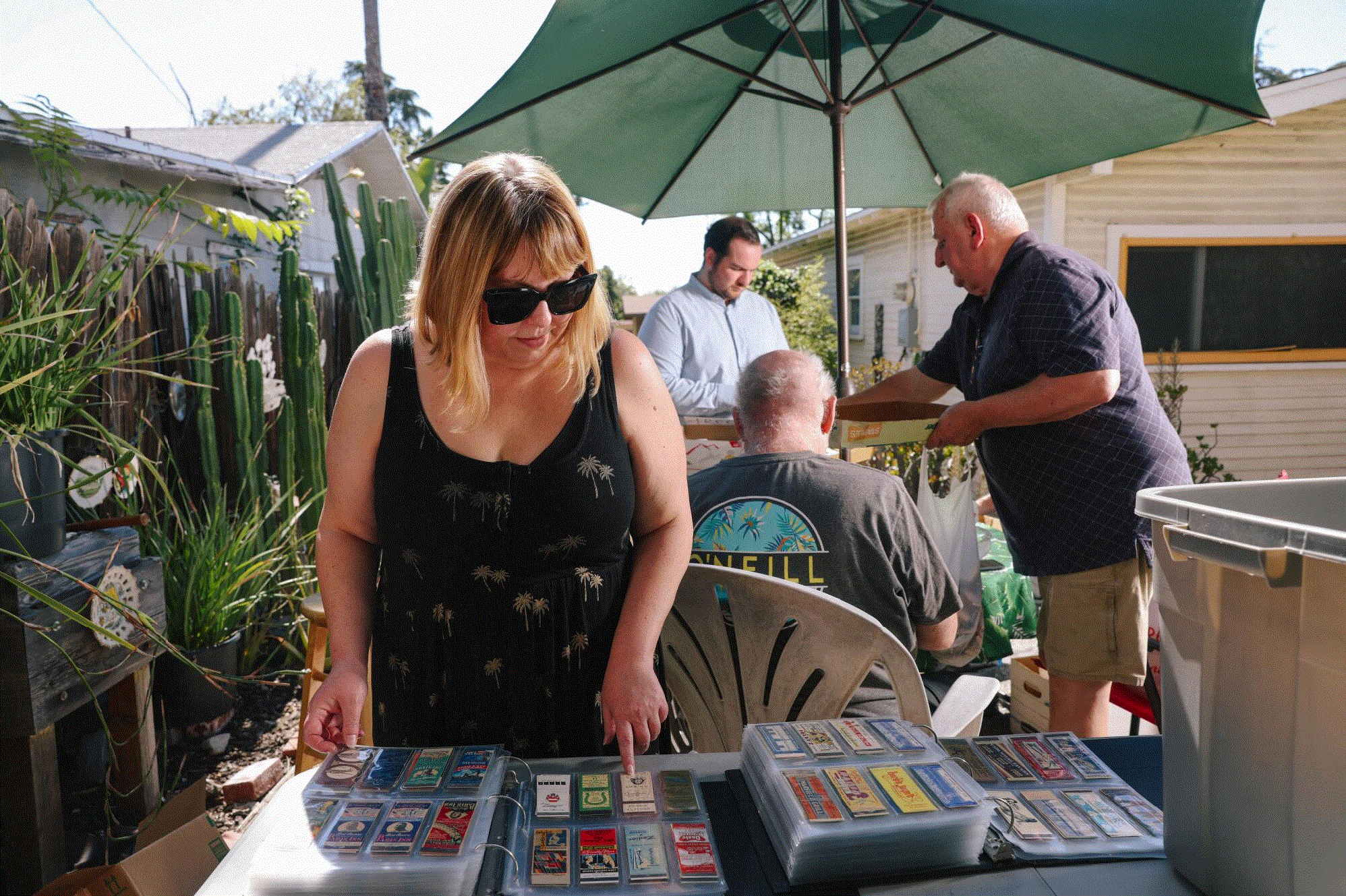
- Joe Burnett shows an album containing some matchbook covers
he has collected from area businesses and organizations. In his
30 years of collecting, he has accumulated approximately 300,000
matchbook covers and boxes from around the world. The next time
you need a match, ask Joe Burnett. Of course the matchbook may
be devoid of matches and the boxes sealed in acrylic frames but
over the last 30 years, the avid collector has accumulated two
rooms full of combustible history.
Burnett has his collection well organized. One room is full of
shelving containing albums with the standard 20-strike match
covers, while the other room contains 30- and 40-strike covers.
Small boxes containing matches are mounted in a sealed frame
and in cabinet drawers. He has organized the albums by type,
World War II, hotel chains by name, old restaurants, new restaurants
and tourist attractions. He estimates that his 550 albums contain
800 to 1000 covers each. Burnett, former owner of the Equity
Dairy Store, previously had a passion for baking pies and still
turns out a good fruit pie once in a while. Ill bet
I baked over 30,000 pies over the years; if the crust isnt
good, the whole pie wont taste good, he said. Burnett,
who used to live above the store on Main Street, moved to his
present home three years ago and now has the room and accessibility
to organize his collection.
Burnett, who served 22 months in the Navys amphibious unit
during World War II, seems the most proud of his collection from
that era.Most of the larger ships had their own matchbooks.
I have covers from ships that were in the Coral Sea: the Wasp,
Hornet, Lexington and Yorktown. The Juneau is the ship where
the five Sullivan brothers died. Then there was the US Thresher,
a sub that sank off Massachusetts in the early 1950s, he
recalled.
- Burnett has a few matchbook covers featuring generals from
that war era, including Douglas McArthur, but doesnt have
a completed set yet. He pointed out that many covers from that
era contained slogans outside and inside, such as a big X over
Hitlers face and slogans promoting rationing and patriotism.
Burnett related a little history about his collections of hotel
and motel chain covers.
In the 1930s, people started traveling more once automobiles
were manufactured. At first there were tourist cabins, which
cost $1 a night; $2 got you a room with a bath and a radio. Steam
heat was a big selling point along with inner spring mattresses,
he laughed.
Burnett also has a nice collection of casino and celebrity matchbook
covers, which he calls billboards, including Bob
Hope, Frank Sinatra and Loretta Lynn.Most of them are 30-
or 40-strike covers. The square ones are called jewels because
theyre so brightly-colored. For many years, Caesars
Palace was the same color; gray, he explained.
So how does Burnett manage to keep collecting in this day of
anti-smoking laws? I go to conventions; the biggest one,
Rathskamp, will be in August in St. Louis. It was founded by
five guys in 1939 in New York, he replied. I belong
to this group and the membership fee allows members to go to
the annual convention and get free matchbook covers. Theres
about a million covers placed on six poker-size tables and we
pick out what we want. Then in the evening, members go door to
door in the hotel to see if anybody wants to trade what they
picked out. Ill probably come home with 5,000 to 10,000
covers this year.
He has accumulated friends over the years, mostly from Canada
and England, with whom he occasionally trades covers.So while
Burnett doesnt think highly of the anti-smoking laws currently
in place, he is sure that there will always be somebody out there
asking, Brother, can I have a light?
|
-
|
June 11, 2007: John Gavenonis, PA, sent this
article in from the Plain Dealer, OH?

|
-
- Big Boy Matchcover Collector Michael
Samuel
-
- May 7, 2007, Ephemera
When not collecting matchcovers, Michael Samuels runs an international
trade and political consulting company based in Washington, DC.
Recently, I spoke with him about his unique matchcover collection,
which focuses on matches from the Big Boy chain of restaurants.
-
- ephemera: When did you begin collecting Big Boy matchcovers?
-
- Samuels: As a youth growing up in Youngstown, Ohio, I began
collecting matchcovers. My family would occasionally go to Cleveland
to visit relatives, and one of my favorite stops was at a Manners
Big Boy Restaurant--for a great hamburger. As I grew older, I
moved from Youngstown , and I stopped collecting matchcovers.
Many years later, in the 1980s, I began collecting matchcovers
again. I came across a couple of Big Boy covers and added them
to my new collection. Eventually, after adding some more Big
Boy covers, I noticed that there were several different Big Boy
franchises. I started making a list of the covers I had and let
other matchcover collectors know what I was doing.
-
- Over time, other collectors shared copies of covers they
had that I did not, and the list began to grow. More and more
collectors expressed an interest, and we created a club that
meets annually at the annual convention of the Rathkamp Matchcover
Society, the national club of matchcover collectors. So far,
we have been able to identify 513 different Big Boy matchcovers
from 23 different franchises, and I have 451 different covers.
Five franchises have three or fewer matchcovers, while a few
have very many. The two with the largest number are Shoneys
(103) and Bobs (77). Quite a few matchcovers do not identify
a specific franchise, but are generic Big Boys.
-
- ephemera: Who knew there were so many Big Boys! What challenges
or obstacles do you encounter in finding new items for your collection?
-
- Samuels: The hobby of matchcover collecting, called Phillumeny,
has suffered in recent years. First, during the 1980s, there
was an expansion of the use of disposable lighters, and the demand
for matches diminished. Subsequently, with the reduction in smoking,
there has been a significant reduction in the tradition of restaurants
giving out matchcovers as advertising. There has also been a
significant reduction in the number of Big Boy franchises and
restaurants. Thus, new covers are not being produced at all--or,
if they are, only infrequently. However, every year a dozen or
so previously unknown older covers appear, as their previous
owners pass them to collectors of Big Boy matchcovers.
-
- ephemera: Which, I gather, makes the existing Big Boy matches
more valuable with each passing year. What are your favorite
items?
-
- Samuels: Covers from Big Boy restaurants outside the U.S.--so
far, I have covers only from Japan and Canada. Also, covers from
the early days--1930s and early 40s--that show the Big Boy logo
as a fat boy with his trousers only half hanging on. Also, a
few of the covers were features, meaning the match sticks themselves
had art on them.
-
- ephemera: What's your advice to achieving success as a collector?
-
- Samuels: It is important to interact with other collectors
of Big Boy matchcovers and look for opportunities to trade. Such
trades can be Big Boy matchcover for Big Boy matchcovers, Big
Boy matchcover for a matchcover with another theme or Big Boy
matchcover for some other unrelated collectible. On-line auctions,
such as eBay often have Big Boy matchcovers for sale. Finally,
occasionally estates with matchcover collections or just accumulations
may have these matchcovers.
-
- ephemera: What resources and tools do you recommend?
-
- Samuels: Probably the best tool is the listing of Big Boy
matchcovers that is available to members of the Big Boy Matchcover
Club. Membership is open to anyone, and the cost is very reasonable
-- $5.00. This will also lead to knowledge of other collectors,
and trading becomes more possible. Today, most collectors keep
their matchcovers in special plastic pages, designed for the
various matchcover sizes to fit into them.
-
- ephemera: Thanks, Michael. The Big Boy is one of America's
most endearing brands. I've been a fan since Bruce Springsteen
referenced Bob's Big Boy in the song, Open All Night.
|
Back to RMS Home Page
|